A Comprehensive Guide to Back and Lay Betting in the Indian MarketUnderstand Back and Lay Betting in India
If you've opened a betting app and felt overwhelmed by the blue and pink boxes—almost like looking at a complex spaceship dashboard—you aren't alone. Most Indian bettors are used to the 'classic' way: you pick a team, put down ₹100, and hope for the best.Blue and Pink boxes and felt like you were staring at a rocket ship control panel, you’re not alone. Most people in India grow up with “traditional” betting—you pick a team, you bet ₹100, and you wait.
Betting Exchanges, such as Betfair or platforms like Lotus365, operate on a totally different logic. Rather than a typical gambling site, think of it as a digital marketplace.Betting Exchange (platforms like Betfair or local interfaces like Lotus365) is a completely different beast. It is not a gambling den; it is a Marketplace.
Table of Contents
The Mindset Shift: You are the Market
In a standard sportsbook, you're playing against the house; if you win, the company loses. On an Exchange, however, you're betting against other real people, like someone from Delhi or Mumbai.
- Think of the Exchange as the OLX of betting: one person is looking to sell a specific outcome (Lay), while another is looking to buy it (Back).The Exchange is like OLX: One person wants to sell a phone (Lay), and another wants to buy it (Back).
- It's very similar to the Stock Market: you essentially 'buy' a team's shares when the price is low and 'sell' them once the value climbs.The Exchange is like the Stock Market: You buy a “stock” (a team) when it’s cheap and sell it when the price goes up.
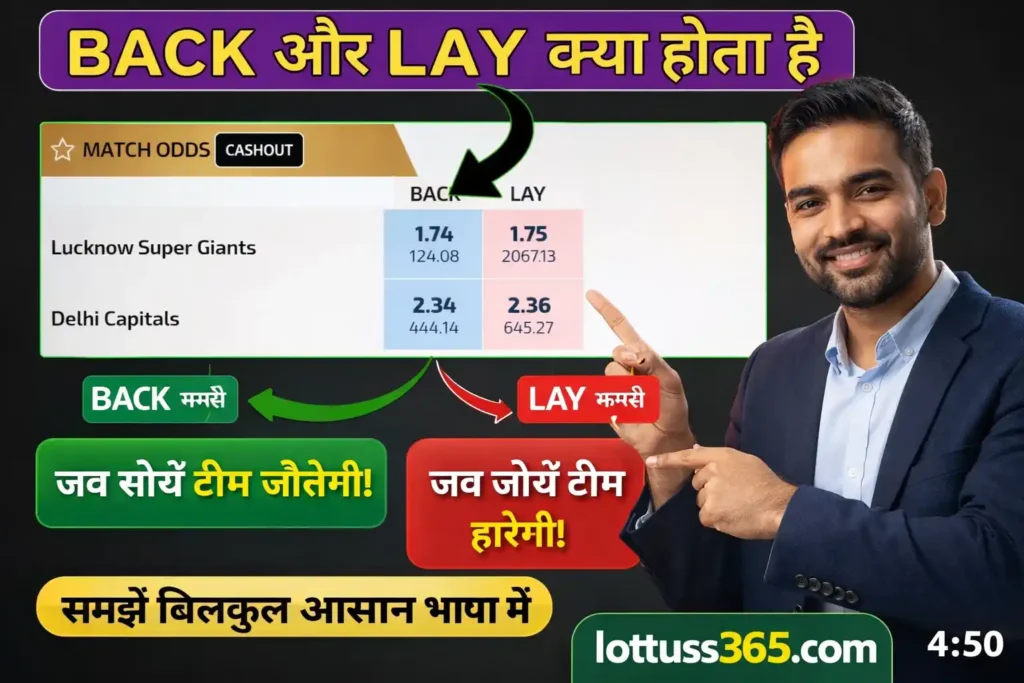
Back Betting: The “Yes” Button 🔵
Backing is the traditional form of betting. Simply put, you are betting 'YES' that a specific event will occur.Backing is what we all know. It means you are saying: “YES, this will happen.”
By selecting the Blue Box, you are rooting for a team. Your bet pays out only if that specific team emerges victorious.Blue Box, you are supporting a team. You win only if that team wins the match.
The Practical Cricket Example
Imagine an IPL clash: CSK vs. RCB.
- Your Move: You Back CSK at 2.0 odds.
- Stake: ₹1,000.
- Example A: If CSK wins, you get your ₹1,000 stake back plus a ₹1,000 profit, totaling ₹2,000.Scenario A: CSK wins. You get your ₹1,000 back + ₹1,000 profit = ₹2,000.
- Example B: If CSK loses or the game ends in a tie, your ₹1,000 stake is gone.Scenario B: CSK loses or it’s a Tie. You lose your ₹1,000.
The basic rule here: Backing is for the fans—it's about cheering for a specific result.The Rule: Backing is for fans. You are cheering for an outcome.
Lay Betting: The Power of the 'No' Button 🔴
When you 'Lay,' you are essentially betting 'NO'—predicting that a certain outcome will not happen. While this confuses many beginners, it's actually the most potent tool in your arsenal.Laying means you are saying: “NO, this will NOT happen.”
By clicking the Pink Box, you're stepping into the shoes of the bookmaker. You win as long as the chosen team doesn't win (meaning they lose or tie).
The “Liability” Trap
Unlike standard bets, Laying isn't just about the amount you want to win. You are taking on the responsibility to pay out anyone who 'Backed' that team. This potential loss is known as your 'Liability.'Liability.
For instance, imagine Laying RCB at 3.0 odds with a ₹1,000 stake.Example: Laying RCB at 3.0 odds with a ₹1,000 stake.
- You are saying: “RCB will NOT win.”
- Scenario A: RCB loses the match. You pocket the ₹1,000 stake from the person who backed them.Scenario A: RCB loses. You win the ₹1,000 stake from the other person.
- Scenario B: RCB wins. You are responsible for paying the profit owed to the person who backed RCB.Scenario B: RCB wins. You must pay the profit to the person who backed them.
- The Math: $(3.0 – 1) \times 1,000 = ₹2,000$ Liability.
A word of caution: Laying at high odds can be dangerous. For example, at 10.0 odds, you might risk ₹9,000 just to make a ₹1,000 profit. Always calculate your liability before confirming.A word of caution: Laying at high odds can be dangerous. For example, at 10.0 odds, you might risk ₹9,000 just to make a ₹1,000 profit. Always calculate your liability before confirming.
The 'Green Book' Method: Securing Profits Regardless of the Final Score
Professional traders don't just guess the winner; they treat the exchange like a financial market. In the IPL, odds fluctuate with every delivery, and you can use this volatility to lock in a guaranteed profit.Trade. In the IPL, odds change after every single ball. You can use this “Volatility” to lock in a profit.
The “Back-to-Lay” Blueprint
- Phase 1 (The Back): Before the match, you think Rajasthan Royals (RR) are undervalued. You Back them at 4.0 odds with ₹1,000.
- Position: If RR wins, you make ₹3,000.
- Phase 2 (The Pivot): Suppose Jos Buttler smashes three sixes in the opening over, causing RR's odds to plummet to 1.5.Phase 2 (The Shift): Jos Buttler hits three sixes in the first over. RR’s odds “crash” down to 1.5.
- Phase 3 (The Lay): Now you Lay RR at 1.5 for ₹2,000.
- The Outcome: By adjusting your position, you've covered both your stake and your liability. Now, no matter who wins, your 'book' is green, and you've secured a profit before the match is even over.The Result: You have now covered your initial stake and your liability. No matter who wins the game, your “Book” turns Green. You walk away with profit before the match even ends.
Best Situations for Indian Markets
The Indian landscape is heavily driven by a passion for Cricket, Football, and Tennis. Here are some tailored approaches:Cricket, Football, and Tennis. Here is how to play them:
A. Cricket (The King)
- The Toss Strategy: If a captain known for batting first wins the toss on a batting-friendly pitch, 'Back' them immediately. The odds usually drop the moment they start scoring.The Toss Market: If a captain who always bats first wins the toss on a flat pitch, “Back” them immediately. The odds will drop as soon as they start hitting.
- Fancy Bets (Innings Runs): If a powerhouse like Virat Kohli is batting and the 'Over/Under' for the next 5 overs is set at 45, you might 'Lay' the over if you notice the pitch is starting to turn.Innings Runs (Fancy): If a superstar like Kohli is at the crease and the “Over/Under” for the next 5 overs is 45 runs, you can “Lay” the over if you see the pitch is turning.
B. Football (The Goal Market)
- Laying the Draw: A staple strategy. Lay the draw at the start of a football match. Once a goal is scored, draw odds typically spike, allowing you to 'Back' the draw and lock in a profit.Lay the Draw: A classic strategy. Lay the draw at the start. As soon as any team scores a goal, the odds for a draw skyrocket. You then “Back” the draw to lock in profit.
Smart Indian “Tricks” & Timing
On an exchange, your timing is far more critical than your ability to predict the final score.Timing is more important than Prediction.
| Trick | How it Works |
| The Underdog Back | For example, Back a team like PBKS at high odds (e.g., 5.0). If they secure two early wickets, the odds will drop to 2.5; that's your cue to Lay them and exit with a profit. |
| Low Odds Lay | Alternatively, Lay a heavy favorite like India at 1.2 odds. If a key player like Rohit or Surya gets out, the odds might jump to 1.6, allowing you to cash out quickly with minimal risk. |
| Momentum Trading | In T20, momentum is everything. If a bowler is leaking runs, “Back” the batting team for that specific 6-over window. |
Common Pitfalls: Avoiding 'Punter' Mistakes
To keep your bankroll safe during the IPL season, avoid these four frequent errors:
- Forgetting Liability: Never hit that pink button without double-checking the 'Liability' amount shown on your bet slip.Ignoring Liability: Never click the pink button without looking at the “Liability” figure at the bottom of your bet slip.
- Chasing Losses: If a 'Back' bet fails, don't try to recover by 'Laying' the next team with double the money. This is the fastest way to empty your account.Chasing Losses: If you lose a “Back” bet, don’t “Lay” the next team with double the money just to recover. This is how “clean sweeps” (losing everything) happen.
- Holding on Too Long: Greed can be costly. If you're up ₹500 and the momentum shifts, take your profit. It's better to have a 'green book' now than to hope for ₹1,000 and end up with nothing.Holding Too Long: In an exchange, “Greed is your enemy.” If you are in a ₹500 profit and the match is turning, Exit. Don’t wait for the full ₹1,000. A green book is better than a “hope” book.
- Lack of a Stop Loss: Set a hard limit before the game starts—for example, 'If I lose ₹1,000, I'm done for the day.'Not Using a Stop Loss: Decide before the match: “If I lose ₹1,000 today, I am closing the app.”
Safety, Security, and Taxes in India
Now, let's cover the essential, though less exciting, details.
- Taxes: In India, online gaming and betting winnings are subject to a 30% tax under Section 115BB. Legal platforms will likely deduct TDS on wins over ₹10,000, so keep your withdrawal records for your tax filings.Taxes: In India, winnings from online games/betting are taxed at 30% under Section 115BB. If you use a legal Indian platform and win over ₹10,000, they will likely deduct TDS. Keep a record of your withdrawals for your ITR.
- Security: Stick to platforms with verified exchange licenses. Be very careful with 'local agents' on WhatsApp, as they often vanish when it's time to pay out large Lay winnings.Safety: Only use platforms that have a verified “Exchange” license. Be wary of “local bookies” on WhatsApp; they often disappear when it’s time to pay out large “Lay” winnings.
- Bankroll Control: Divide your total capital into 20 equal units. Never risk more than one unit (5%) on any single event.Bankroll Management: Divide your total money into 20 parts. Never put more than one part (5%) on a single match.
How to Start (The 5-Day Plan)
Don't dive in with ₹10,000 on your first day. Try this gradual approach instead:
- Days 1-2: Observation mode. Open the app during a live match and simply watch how the odds react to events like a wicket falling. Do not place any bets.Day 1-2: Just watch. Open the exchange during a live match. Watch how the numbers change when a wicket falls. Don’t bet.
- Day 3: Start small. Place a modest 'Back' bet of ₹100 on the favorite.Day 3: Place a “Back” bet of just ₹100 on the favorite.
- Day 4: Try a 'Lay' bet of ₹100 on something unlikely (e.g., a team needing 30 runs in the final over) to get a feel for how liability works.Day 4: Place a “Lay” bet of ₹100 on an outcome you’re sure won’t happen (like a team needing 30 runs in the last over). Understand the liability.
- Day 5: Attempt your first 'Back-to-Lay' trade. Try backing at 3.0 and laying at 2.0. Even a tiny ₹20 profit proves you've mastered the mechanic.Day 5: Try your first “Back-to-Lay” trade. Back at 3.0, and try to Lay at 2.0. Even if you make ₹20 profit, you’ve learned the skill.
Pro-Level FAQ
Is Laying safer than Backing?
Theoretically, yes. When you Lay a team, you win if they lose OR if the game ends in a draw. This gives you two paths to victory, though the financial risk (liability) is often higher.OR if the match is a draw. You have two ways to win. However, the risk (liability) is often higher.
Can I use Back and Lay on my phone?
Yes, platforms like <a href=\"https://lottuss365-game.net/\">Lotus365</a> and other Betfair-based interfaces are mobile-friendly. Since odds move in milliseconds, a fast 5G or Wi-Fi connection is essential.Lotus365 or various Betfair-integrated “Skins” are optimised for mobile. Speed is key—make sure you’re on 5G or stable Wi-Fi because odds change in milliseconds.
What is “Courting the Market”?
This happens when you aren't satisfied with the current price. You set a 'Back' bet at slightly higher odds and wait for another user to 'Match' it. If the market shifts in your favor, your bet is executed.